

The short answer
What are the five stages of AI in an organization?
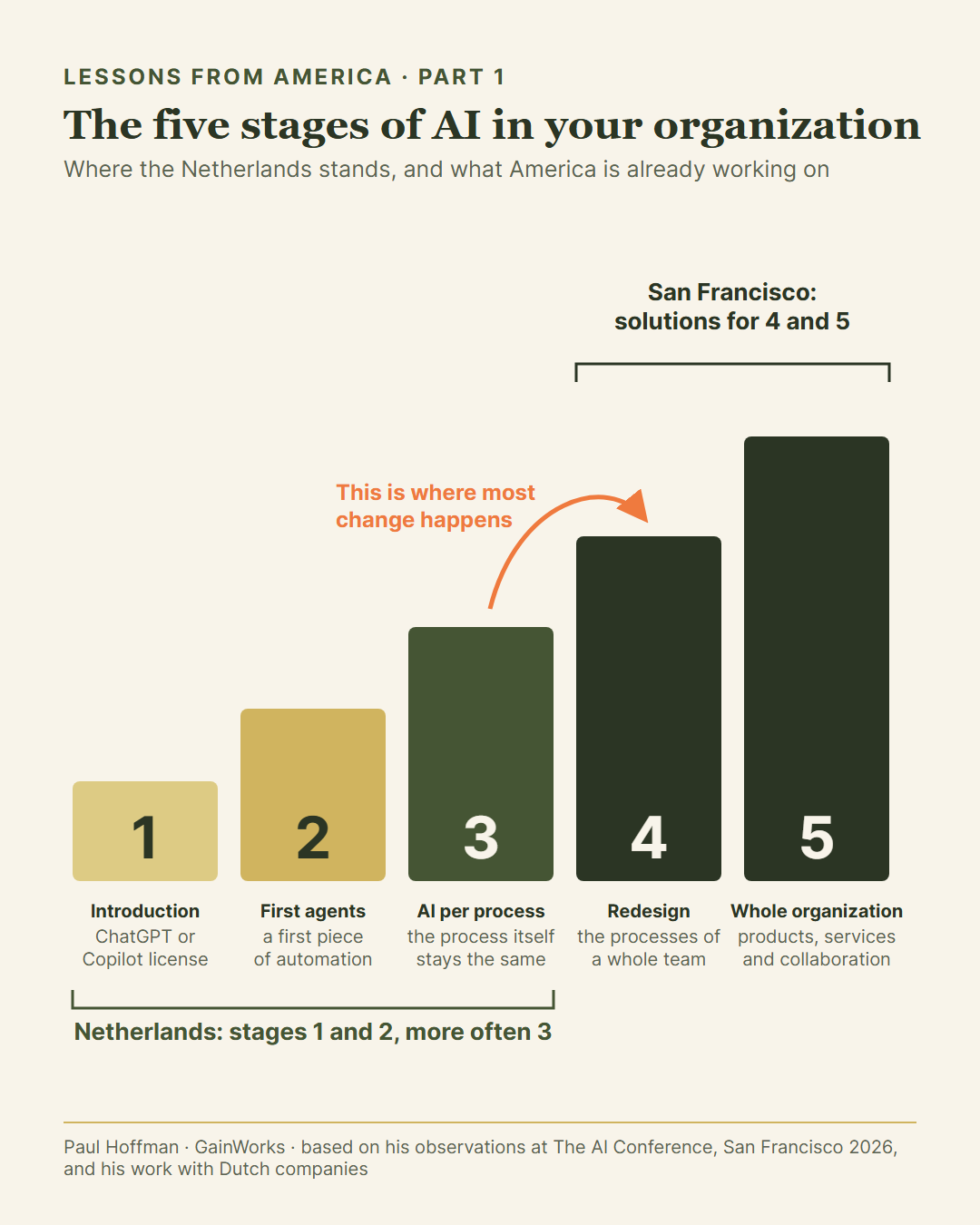
The five stages of AI describe how far an organization has come in its AI transition. They run from a single license to an organization that has been redesigned around AI.
At the end of September I was at The AI Conference in San Francisco. The difference with the Netherlands became very visible there. In the video above I explain the five stages at the whiteboard. Below they are set out one by one, with what I saw in America and what the figures say about it.
The five stages
What happens in each stage?
Each stage changes more: first the work of one employee, then one process, then the work of a whole team, and finally the organization itself.
Stage 1: the introduction
An organization buys a license for ChatGPT or Copilot, and employees start asking an AI assistant questions. That saves an employee time. The way the company works does not change yet.
Stage 2: the first agents
An agent is an AI assistant that carries out a fixed task with fixed instructions. Stages 1 and 2 often go together. The first agents bring the first piece of automation into the company.
Stage 3: AI per process
Next, an organization looks at what AI does to each process. It often turns out that a process, the way it has always run, no longer makes much sense. Still, the process stays the same in this stage: agents take over part of the work, but the work itself does not change.
Stage 4: redesign for a whole team
In stage 4 you redesign processes that belong together, from the ground up. This happens at the level of a team or a cluster of processes. The question then is what the work, and the organization, would look like if you set it up again today.
Stage 5: the whole organization
An organization is a stack of processes and teams. When the whole organization changes, its products, its services and the way it works with others change as well.
The biggest step
Why is the step from stage 3 to stage 4 so big?
The step from stage 3 to stage 4 is the biggest, because there you no longer speed up existing work, you change the work itself.
From stage 3 to 4 is where most business change happens. This step from 3 to 4 is often also the most complex.Paul Hoffman, in the video
Up to and including stage 3, AI makes existing work faster. In stage 4 the work itself changes, and with it tasks, roles and sometimes the question of who decides what. That affects people, which is why it is harder than a new license or a clever agent.
This is also the core of our white paper AI Unveiled: not how you add AI to your work, but what your work looks like when you design it around AI.
My reading
Where do Dutch companies stand, and where does America stand?
Dutch companies are mostly in stages 1 and 2, and more and more often in stage 3. The organizations I spoke with in San Francisco were already working on stages 4 and 5.
All the organizations I spoke with in San Francisco, and that is of course the spearhead of AI, all had solutions for stages 4 and 5.Paul Hoffman, in the video
That picture comes from my conversations at the conference and from my work with Dutch companies. These are observations, not measurements. My own estimate is that America is two to three years ahead here.
The difference is not in use. According to the Stanford AI Index 2026, 91 percent of surveyed organizations in Europe used AI in 2025, against 90 percent in North America. The difference is in the money: for 2025 Stanford counts $285.88 billion of AI investment in the United States, against $20.92 billion in Europe.
How fast that market moves shows in our own count at GainWorks. Of the 74 exhibitors at The AI Conference in 2025, 24 were back in 2026.
That America is ahead is no cause for concern. It gives us a good preview of the problems and solutions that will play out here too.
In practice
What does this mean for your organization?
First work out which stage your organization is in, and look beyond that one process as early as stage 3.
- Look beyond one process: an agent in a process that really needs redesigning mostly makes an old way of working faster.
- Think at team level: the biggest gains are in processes that belong together, not in one separate task.
- Learn from those ahead: what is happening in San Francisco now will come here too. In part 2 I discuss the solutions for stages 4 and 5 I saw most often there.
Want to know where AI pays off most in your organization? The BORS pre-scan shows in five short questions whether a full BORS fits you.
Frequently asked questions
What is an AI agent?
An AI agent is an AI assistant that carries out a fixed task with fixed instructions, for example summarizing every incoming quote request in the same format. Where an ordinary assistant waits for a question, an agent does the same work the same way every time. In the five stages, the first agents belong to stage 2: the first piece of automation in an organization.
How do I know which stage my organization is in?
Look at what AI changes today. If employees mostly use separate AI assistants, you are in stage 1 or 2. If AI runs inside a fixed process that otherwise stays the same, you are in stage 3. Only when the processes of a whole team have been redesigned are you in stage 4.
Do American companies use more AI than European ones?
No, not when it comes to use. According to the Stanford AI Index 2026, 91 percent of surveyed organizations in Europe used AI in 2025, against 90 percent in North America. The difference lies in how far companies go: in America they are already redesigning whole teams and organizations.
What is The AI Conference?
The AI Conference is a conference on AI in San Francisco. The 2026 edition ran from September 29 to October 1 at Pier 48. That is where I spoke with the organizations I describe in this piece, and where the lessons in the next parts come from as well.
What is part 2 of Lessons from America about?
Part 2 covers the solutions for stages 4 and 5 that I came across most often in San Francisco. Part 1 sets out where the Netherlands and America stand. Part 2 shows how American companies are now taking the big step toward redesigning their work.
Sources
The idea, the concept and the corrections of substance are Paul Hoffman's. AI corrected the language, ordered the text and improved readability. The video was recorded on October 15, 2026, in Dutch. The facts were checked on October 20, 2026 against the sources below. The division into five stages and the observations from San Francisco are Paul Hoffman's own: they are observations, not measurements.