

The short answer
What are the five levels of AI in a company?
The five levels describe how far AI has reached into your company, from a single license to agents that work with those of other companies.
The levels build on each other, but you do not have to finish them one by one. The higher you go, the more it becomes a matter for management and the board, and the longer it takes.
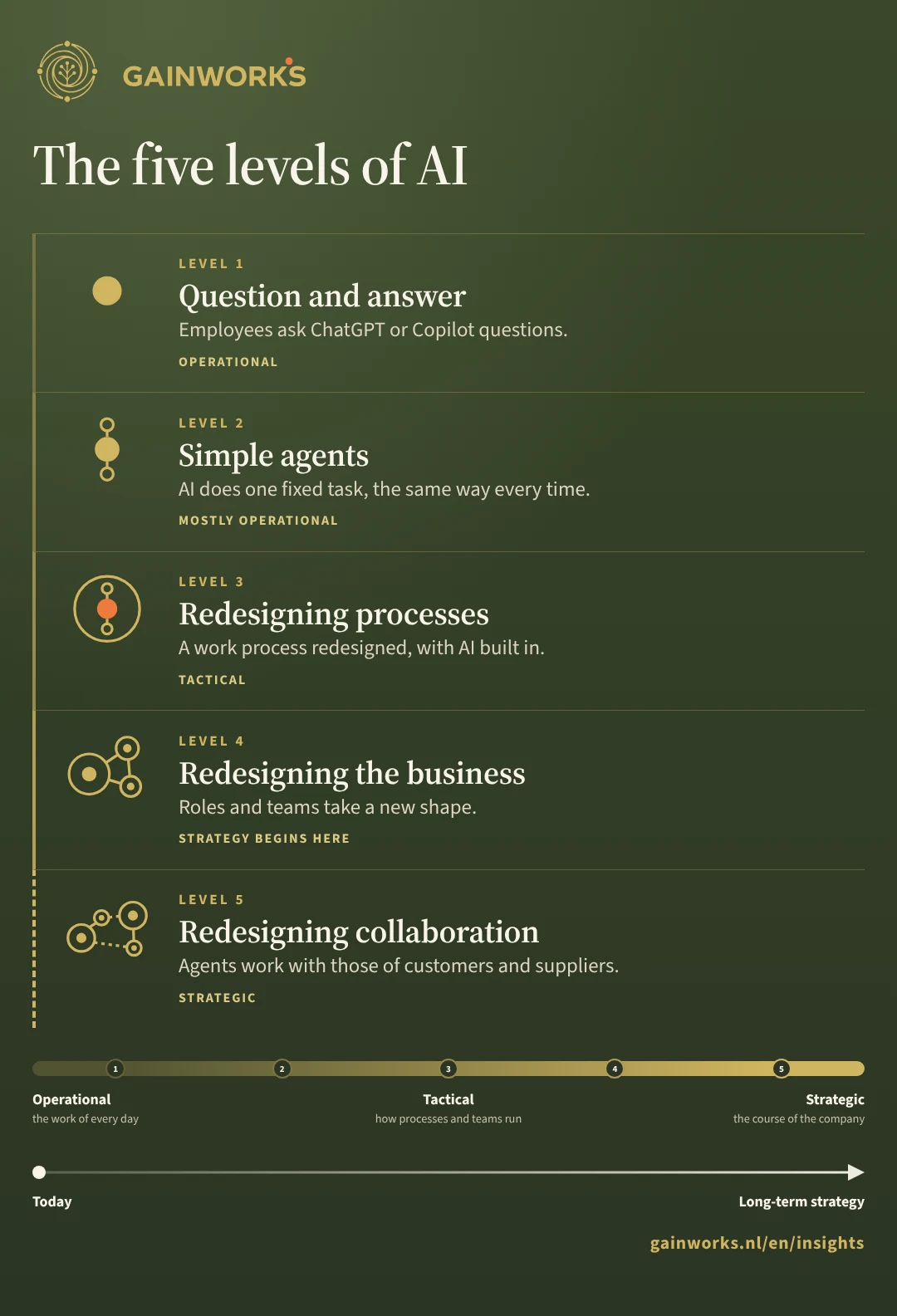
The five levels
What happens at each level?
The levels build on each other. What a level asks still holds for everything you build above it.
Level 1: question and answer
A company takes a license for ChatGPT, Copilot or Claude, and employees ask an AI assistant questions. That saves each person time in their own work. The work itself still runs the way it always did.
In my book De Informatiemotor I put the gain at this level at ‘a tenth of what there is to gain, at most’. It does need business accounts, agreements on which information may go in, and people who know how to check an answer from AI.
Level 2: simple agents
At level 2 you give AI one fixed task, with a fixed instruction, your own data and an owner who keeps an eye on it. Such a fixed task is called an agent, for example an agent that summarizes every quote request in the same format. The process stays the same, and the agent becomes a new link in the old chain. That takes repetitive work away, in my book ‘roughly a third of what there is to gain’.
Level 3: redesigning processes
At level 3 you put the process as it always ran aside and design it again, with the people who know the work at the table. The person does the judgment, the agent the volume. For that you first measure how long the work takes now, write down what words like customer and order mean, and agree where someone checks. In the book I call that the view of the blank sheet, and that is where the big gain is: ‘This is where the rest of the gain is, and that is by far the most.’
Level 4: redesigning the business
When several processes have been redesigned, the business itself changes. Roles shift from doing to steering and checking, and teams get their own digital employees. People steer, agents carry out, and every agent has a person who is responsible for it.
Level 5: redesigning collaboration
At level 5 your agent does business with your supplier’s agent: one targeted question, and today’s answer. A schedule between two companies is then made by agents and signed by people. That comes with agreements on what an agent may do, with whom, and who is liable when it goes wrong. This level is still under construction.
From the work floor to the boardroom
Who decides at which level?
Levels 1 and 2 are mostly about the work floor. Level 3 is work for management, and from level 4 it sits at the boardroom table.
At level 1 it is about the daily work: which tool, which account, what may and may not go in. Level 2 brings the first tactical choices: which work an agent gets and who owns it.
At level 3 it is about how a process runs, and that is work for management. At level 4 roles and teams change, and the board decides on that. Level 5 is about agreements with customers and suppliers, and the board makes those too.
Why it takes time
Why is AI more than buying a tool?
Buying a tool puts you at level 1. The steps after that touch processes, roles and partners, and you do not take them in one go.
Buying licenses alone makes employees’ own work a little faster. The way the company works stays the same. The gain further on needs choices from management and the board. You make those in an order: first one process, then more processes, then the company.
That is why AI needs a long-term strategy. Then you know which level you are building now, and what the next one must rest on.
The biggest steps
Where are the biggest steps?
Two steps stand out. From level 2 to 3 the work itself changes, and from level 3 to 4 the business changes.
Up to level 2, AI makes existing work faster. At level 3 you design the work anew, and according to my book that is where most of the gain is.
At level 4, tasks, roles and sometimes the question of who decides what all change. That affects people, which is why it is harder than a new license or a clever agent.
The step from stage 3 to 4 is where most business change happens. This step from 3 to 4 is often also the most complex.Paul Hoffman, in the video of October 15, still with stages
This is also the core of our white paper AI Unveiled: not how you add AI to your work, but what your work looks like when you design it around AI.
In practice
What does this mean for your company?
First work out which level your company is at, and build the next level on what is already there.
- Start with the basics: business accounts, agreements on what may go in and people who can check an answer. Every higher level rests on that.
- Look beyond one agent: an agent in a process that really needs redesigning mostly makes an old way of working faster.
- Bring in management and the board in time: from level 3 the choices are theirs.
Dutch companies are mostly at levels 1 and 2. How that compares with what I saw in San Francisco is in Lessons from America, part 1.
Want to know where AI pays off most in your organization? The BORS pre-scan shows in five short questions whether a full BORS fits you.
Frequently asked questions
What is an AI agent?
An AI agent is an AI assistant that carries out a fixed task with fixed instructions, for example summarizing every incoming quote request in the same format. Where an ordinary assistant waits for a question, an agent does the same work the same way every time. In the five levels, the first agents belong to level 2.
How do I know which level my company is at?
As a rule of thumb: if employees mostly use separate AI assistants, you are at level 1. If agents carry out fixed tasks in processes that otherwise stay the same, it is level 2. Only when one process has been redesigned from start to finish are you at level 3. The Dutch edition of this article ends with a ten-question check.
Who should be involved in AI, the work floor or the board?
Both, only not at the same level. Levels 1 and 2 are mostly about the work floor. From level 3 it is about how processes run, and that is work for management. At levels 4 and 5, roles, teams and the agreements with customers and suppliers change, and the board decides on those.
Can you skip a level?
Yes, you can. A company may already have redesigned a process while not every employee uses an AI assistant yet. So you do not have to finish the levels one by one. What a lower level asks still holds: an agent at level 2 only works well once the business accounts and the agreements of level 1 are in place.
Why levels and not stages?
In my video of October 15 I still spoke of five stages, with a slightly different split. On stage I have used five levels since October: three that go deeper into the work and two that make it wider. This article follows those five levels. The video is part of Lessons from America, part 1.